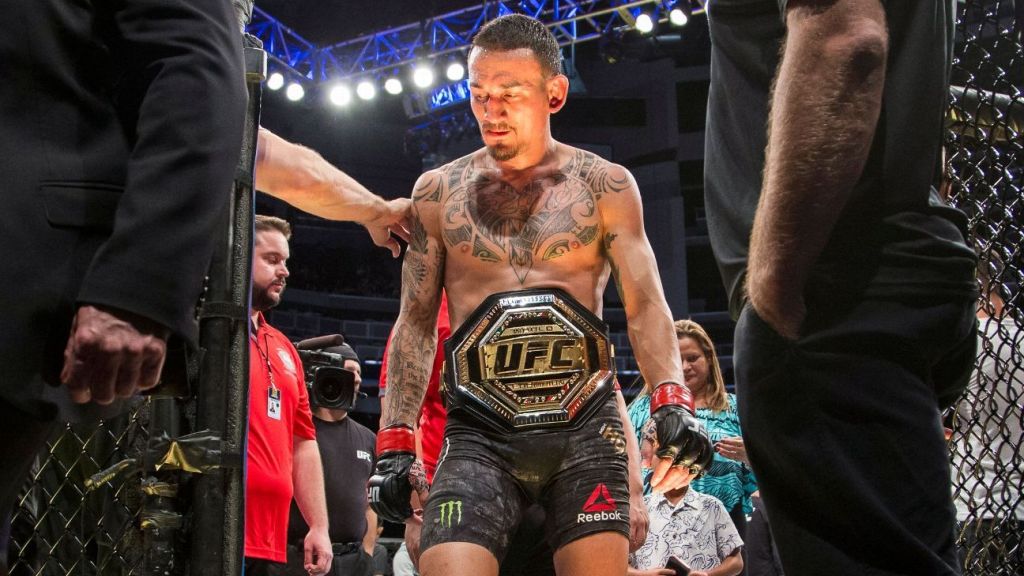
Max Holloway is a representative In-and-Out volume puncher in the UFC, with a strong base in boxing. His boxing skills are considered to be one of the best of all of MMA, evident in his dominant victory over Calvin Kattar, who is highly regarded for his boxing skills. Holloway’s fight strategy is intricate and detailed, reflecting his versatility and exceptional proficiency in various techniques. Regardless of the approach, the overall flow of his fights is remarkably coherent.
- Superior Jab and In-and-Out Movement for Distance Control: Holloway utilizes his superior jab and fast, unorthodox in-and-out steps to control the distance, analyze rhythm, timing, and gather information in the early rounds. This phase focuses on preventing the opponent from analyzing him by employing active defense rather than an aggressive onslaught.
- Aggressive Pressure and Effective Use of Combinations: Once enough data is collected, Holloway applies aggressive pressure, actively engaging in exchanges using combinations. He tends to avoid giving up the center line during exchanges, which consistently puts him in an advantageous position. His proficiency in both initiating attacks and countering offers a wide range of offensive options.
- Finish: When the opponent is sufficiently fatigued or damaged, Holloway pushes them into the fence, leading to a finish. He commonly utilizes a guillotine against opponents, employing a survival-style tactic and employs punch rushes against opponents stalling in a high guard.
To establish such a one-sided flow, a fighter needs superior striking techniques, endurance, resilience to absorb strong punches, instinctive evasion skills, and more. Holloway demonstrates exceptional skills in these aspects.
While being proficient in all techniques, Holloway stands out in short lead jabs, one-twos, counters after pulling back, check hooks, and spinning back kicks. His ability to seamlessly combine these skills based on the situation distinguishes him.
Among these, Holloway’s jab is particularly noteworthy, displaying top-tier quality in MMA. Unlike Georges St-Pierre’s jab, which pierces deeply from a distance, Holloway’s jab is more akin to traditional boxing – light, fast, and prioritizing control over damage. The frequent use of his lead hand in Sweet Science style allows him to manipulate opponents regularly, enabling Holloway to control the distance against opponents with longer reaches.
Moreover, Holloway can freely switch stances between orthodox and southpaw. Although he does not switch constantly from orthodox (his main stance) to Southpaw as much as fighters like Israel Adesanya or Ciryl Gane, Holloway can conduct an entire fight in a southpaw position or seamlessly shift between southpaw-orthodox and vice versa. This unpredictability makes it challenging for opponents to anticipate his movements.
One of the biggest strengths that highlights Max Holloway’s broad striking tactics is his granite-like chin and resilience. His solid chin allows him to absorb powerful punches without flinching, as seen when he took Jeremy Stephens’ hard shot and countered without hesitation. His exceptional cardio and recovery enables him to quickly bounce back even after engaging in a brawl, seizing the opportunity to dominate fatigued opponents. The ability to maintain a performance akin to the early rounds throughout the entire 5 rounds is a significant advantage.
Not only does he possess a durable chin, but his leg endurance is also remarkable. In one of his bouts with Alexander Volkanovski, despite allowing numerous leg kicks, Holloway went to an afterparty and danced, showcasing his ability to withstand kicks to the legs.
However, whether it’s due to confidence in his durability or a desire to entertain the audience, there are instances where he intentionally engages in intense brawls during distance fighting. While showcasing excellent fight IQ, these occasional rough and daring displays add to the appeal, although exposing oneself to unnecessary damage raises concerns about punch drunk syndrome.
One of the dual-natured aspects, both an advantage and a disadvantage, is the perceived lack of power in his strikes. This is somewhat intentional, as Holloway employs a unique striking mechanism. Unlike traditional hip-driven strikes that pack a powerful punch, Holloway sometimes utilizes shoulder-heavy punches (depending on his assessment of the situation), allowing him to throw longer, less powerful punches that consume less energy. While this may reduce the impact of individual strikes, it facilitates sustained, one-sided dominance throughout the rounds. However, as demonstrated in the fight against the Korean Zombie (Chan Sung Jung), when accuracy is prioritized, he possesses the power to secure one-punch knockouts.
In contrast to fighters like Michael Bisping with a somewhat similar striking style, Holloway maintains an aggressive assault throughout the entire 5 rounds. This constant pressure means he can finish opponents at any moment after the third round, contributing to how dangerous he is in the striking department of MMA.
Contrary to some people’s thoughts, Max Holloway possesses excellent defensive head movement and footwork, evident in numerous evasion highlights where he skillfully avoids opponents’ punch combinations during fights. However, embracing an extreme volume-puncher style occasionally results in him getting caught by the opponent’s rear-hand overhand. Nevertheless, Holloway seems to consider it a worthwhile trade-off, as he delivers multiple strikes before receiving one.
While Conor McGregor, once a dominant power puncher in the featherweight division, has moved up to lightweight and welterweight, there are currently no threatening knockout artists in the featherweight division who can challenge Holloway. However, in the heavier lightweight class, he may be vulnerable to significant damage from a single blow from lightweight power punchers like Dustin Poirier and Justin Gaethje. Nevertheless, the introduction of new power punchers like Ilia Topuria in his own division brings him new challenges as well.
Although primarily known as a striker, Holloway’s grappling skills are of a high caliber. In the early stages of his career, weaknesses in wrestling led to struggles, including tapping out to a triangle armbar by Dustin Poirier in his debut and losing to a wrestling specialist like Dennis Bermudez. However, significant improvements in ground game and wrestling have been evident since then. Holloway showcased takedowns and top positions against Jeremy Stephens, and he adeptly defended Frankie Edgar’s takedown attempts, securing a unanimous decision victory. Despite lacking a wrestling background, his cage wrestling skills are now superior to many MMA fighters, making it inefficient to press Holloway against the cage as it was in the past.
His ground game has also evolved, with fewer instances of being taken down, and even if taken down, he quickly gets back up or maneuvers to escape cage control. When in a superior position, he exhibits a quarter guard, mount, and back mount sequence reminiscent of BJ Penn in his prime. His ground-and-pound, particularly from the mount, is effective.
Holloway’s ground game has seen considerable growth, and his defensive skills, including rapidly getting back on his feet or escaping from cage control, are notable. When in a dominant position, he smoothly transitions between quarter guard, mount, and back mount, resembling the meta seen during BJ Penn’s prime. His guillotine choke, part of his takedown defense arsenal, is highly threatening. He successfully secured mount guillotine submissions against Cub Swanson and Andre Fili and even attempted a guillotine against the elite Brazilian jiu-jitsu practitioner Brian Ortega.
However, Holloway struggles against opponents with strong striking and significant power, such as Conor McGregor, Dustin Poirier and Alexander Volkanovski. Despite possessing volume striking, durability, and recovery, he can be rocked by powerful opponents, requiring strategic defense, solid coverage, or superior evasive abilities to withstand and gain an advantage. Therefore, opponents with strong punching power can capitalize on these vulnerabilities by either enduring Holloway’s volume with resilience or exploiting his weaknesses in long-distance engagements with faster speed.
 StrikeSaga
Leave a comment