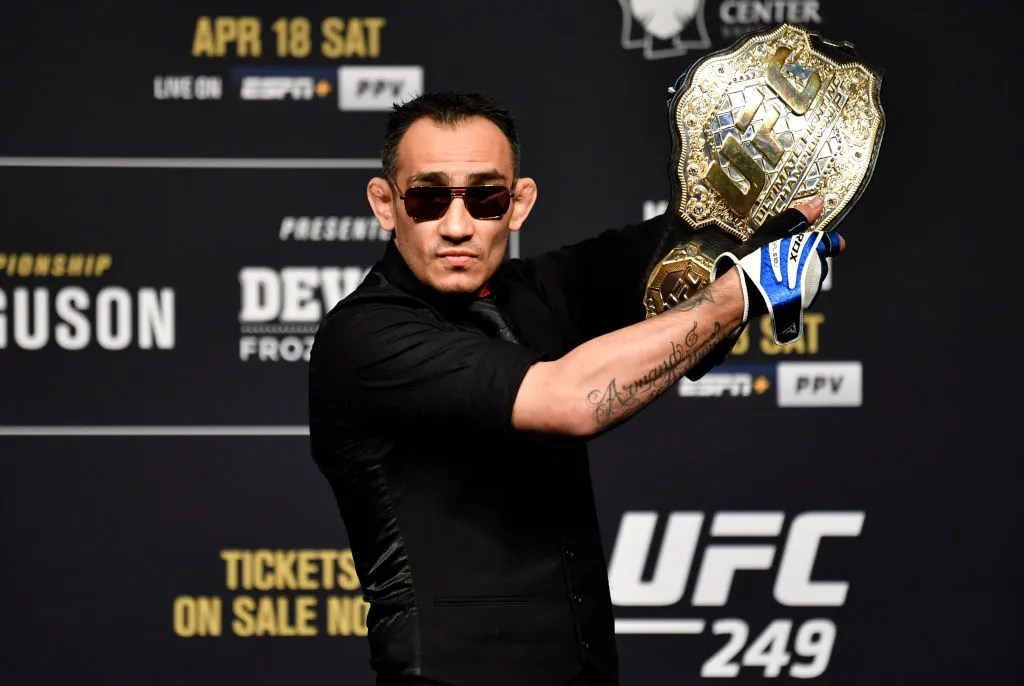
Usually, within the weight class, being tall with an exceptionally long reach is considered a very useful weapon, especially in terms of distance management. However, while fighters with long reach often prioritize out-fighting, Ferguson tends to prefer an aggressive in-fighting style. During matches, along with intense striking exchanges, he lowers his guard, provokes opponents with eccentric attacks that may seem unconventional, and induces enthusiastic reactions from the audience.
With his ability to endure powerful punches with an iron chin, Ferguson enjoys intense and gritty slugfests. Moreover, he has superhuman mental resilience, being able to resist himself from tapping to Charles Oliveira’s armbar and Beneil Dariush’s heel hook (which is something you should definitely tap to, or else it could cause severe and permanent damage to your legs).
Ferguson differently yet effectively utilizes his long reach compared to other fighters, approaching them not with conventional jabs but with switching jabs. His ability to create angles is exceptional, and he masterfully uses elbows. His proficiency in elbows and front kicks is renowned throughout the weight class. As a result, Ferguson’s fights often lead to bloody spectacles. He is also a rare fighter who uses the unorthodox martial art, Wing Chun, with counterattacks involving deflecting the opponent’s punches and responding with opposite-hand elbow strikes.
One of his major strengths is his exceptional stamina, considered among the best in the entire weight class. Leveraging this stamina, Ferguson relentlessly pressures opponents, leading them into a mud-fight scenario, where he wreaks havoc with elbows and brawling. His speed is impressive, allowing him to enter and exit brawls swiftly or instinctively evade significant attacks.
A significant aspect of his victory pattern is countering takedowns when opponents attempt them in crisis situations. Given his wrestling background, Ferguson often grabs the front headlock after sprawling and proceeds to secure a D’Arce choke.
Ferguson is a notorious slow starter, often displaying a lethargic appearance in the first round. Instances where Ferguson faces adversity are mostly concentrated in the first round. Watching his first-round fight with Lando Vannata or Kevin Lee indeed brings tears to one’s eyes. Although the early rounds may raise doubts about his skill, Ferguson’s true prowess shines in these moments of adversity and mud-fight scenarios. Despite barely surviving dire situations and bleeding profusely, he remarkably recovers and appears in the next round. His ability to turn the tide in relentless battles creates remarkable scenes akin to those seen in comics or movies, often resulting in comeback victories.
Due to his fighting style, Ferguson tends to show signs of being a slow starter early in the game, but there is a reason for this in his training. Unlike many top-ranked MMA fighters who gather at All-Star gyms, Ferguson recruits specialist coaches in various MMA disciplines, such as striking, jiu-jitsu, and wrestling, to focus solely on improving his skills. While this training approach has clear advantages, it also has drawbacks. The advantage lies in Ferguson’s dedication to intensive training, leading to significantly more time invested in stamina, skills, and conditioning than most fighters. However, the downside is a lack of high-level sparring partners, resulting in challenges with timing and distance sense in the first round of fights.
Despite his excellent conditioning and relentless pressure leading to a 12-fight winning streak, one of the causes of his first-round adversity is attributed to Ferguson’s training style. Observers are keen to see how he addresses this issue in the future. Professional boxers often improve timing and distance sense by paying high salaries to sparring partners, but in the UFC, unless you are a mega-star like Conor McGregor or Khabib Nurmagomedov, the pay is relatively low.
Ferguson boasts exceptional physical attributes and has added ground skills to his arsenal, capable of aiming for submissions at any moment. He is especially adept at using his long arms for D’Arce chokes, Anaconda chokes, and guillotines. He even received a black belt in jiu-jitsu from Eddie Bravo, the founder of the Twister submission. Leveraging his long arms, Ferguson is famous for employing front chokes, such as D’Arce chokes, Anaconda chokes, and guillotines. His prowess in elbow attacks and his comfort in diving for submissions make him stand out.
His ground game is unique yet incredibly effective in the lightweight division, employing unconventional wrestling scrambles, infinite stamina, and strong resilience. Facing takedown attempts, Ferguson often goes for counter chokes after sprawling, showcasing a submission expertise that can counter opponents’ wrestling. While his opponents may get top control, Ferguson exhibits a remarkable ability to handle lower positions effectively. Despite often ending up in inferior positions, Ferguson showcases a powerful response from the bottom, continuously tormenting opponents who attempt to finish him. Even when absorbing strong ground and pound, he withstands and keeps shining with relentless energy, making it extremely challenging for opponents to control him.
Ferguson is active and dynamic from guard positions, actively attempting escapes or submissions, and favoring 6-to-12 elbow attacks. His elbow attacks, especially due to his long reach, are notably threatening, often causing opponents in top positions to suffer and retreat. Consequently, opponents attempting to control Ferguson from the top often tire quickly and fall victim to rare scenes where they are dominated and humiliated. Kevin Lee is considered one of the few who effectively controlled Ferguson in the first round when his stamina was still formidable.
To delve into more detail, Tony’s guard game focuses on sweeps, positioning, unconventional wrestling scrambles, infinite stamina, and a strong ground-and-pound game. Unlike traditional jiu-jitsu specialists who primarily use the guard as a shield to avoid damage, Tony, instead, turns the guard into a counter-attacking position, inducing opponents to grab the top position. His uniqueness lies in creating mud-fight scenarios, even from the bottom, compelling opponents to engage in a relentless struggle. This style, backed by Tony’s infinite stamina and a mindset built on tenacity, makes it nearly impossible for other fighters to emulate. Fans and UFC fighters alike refer to Tony as “Boogeyman” for a reason. Due to his preference for the bottom position, Tony exposes himself more often to being taken down. However, when pinned down, he showcases a more potent response, constantly bothering opponents who rush in to finish him. Additionally, he endures powerful strikes with his formidable mat control, making it challenging for opponents to control him.
Tony often takes bold risks, such as attempting the high-risk deep half-guard, which sometimes results in him being put in inferior positions. Furthermore, while his mat control is impressive, his defense is somewhat lacking, leading to instances where he gets hit in the face or even knocked down. Although he quickly recovers due to his excellent mat control, these defense issues could be critical when facing top contenders or champions. However, in his fight against Rafael dos Anjos, Tony showed more restraint in attempting risky moves, allowing him to avoid significant strikes and present a stable in-fighting performance. Nevertheless, the risk of facing dangerous situations remains due to his love for brawls. Concerns about his performance declining over time are also growing, especially considering the impact of aging, recent knee injuries affecting his form, and the onset of schizophrenia. Additionally, the medication used to treat his condition comes with side effects that are potentially detrimental to an athlete’s physical abilities, metabolism, and overall well-being.
A significant weakness is his relatively advanced age. As of 2024, being 39 years old and competing in the lightweight division, coupled with the natural decline in physical abilities for individuals in their mid to late 30s, most athletes tend to retire around this age. Therefore, Tony, even within the lightweight division, is considered an aging veteran nearing retirement.
All of the aforementioned problems indeed did lead to Tony’s downfall. After the defeat to Justin Gaethje in May 2020, Tony Ferguson, who once dominated as one of the strongest fighters in the lightweight division, is showing a disappointing decline in his performance. This is a typical example of a fighter who experiences a slump after a single loss, even after a string of victories.
Putting aside the fact that the four consecutive losses prior were against top-ranked lightweights, recent performances against Nate Diaz, considered challenging to label as a contender, and a loss to Bobby Green resulted in a six-fight losing streak. In the fight against Diaz, Ferguson noticeably slowed down, demonstrating a decline in physical abilities and accuracy. Additionally, his recent matches against Nate Diaz and Bobby Green highlighted a significant decrease in his overall skill set.
Since his loss to Justin Gaethje, Ferguson has been on a seven-fight losing streak, showcasing a level of performance that can hardly be considered at the contender level. In particular, his fights against Nate Diaz and Bobby Green revealed a diminished level of speed, accuracy, and overall performance, proving a decline in his overall physical abilities.
It is clearly evident that Tony Ferguson’s prime has clearly passed, and his recent performances against Diaz and Green, which he likely would have won during his prime, solidify this viewpoint. His significant decline in skill has led to disappointing losses against both top and mid-tier opponents, raising doubts about whether he can continue competing at a high level in the UFC. This is especially tragic considering that during his prime (in his 12-fight win streak) he was never able to fight for the actual title due to several unlucky mishappenings.
 StrikeSaga
Leave a comment