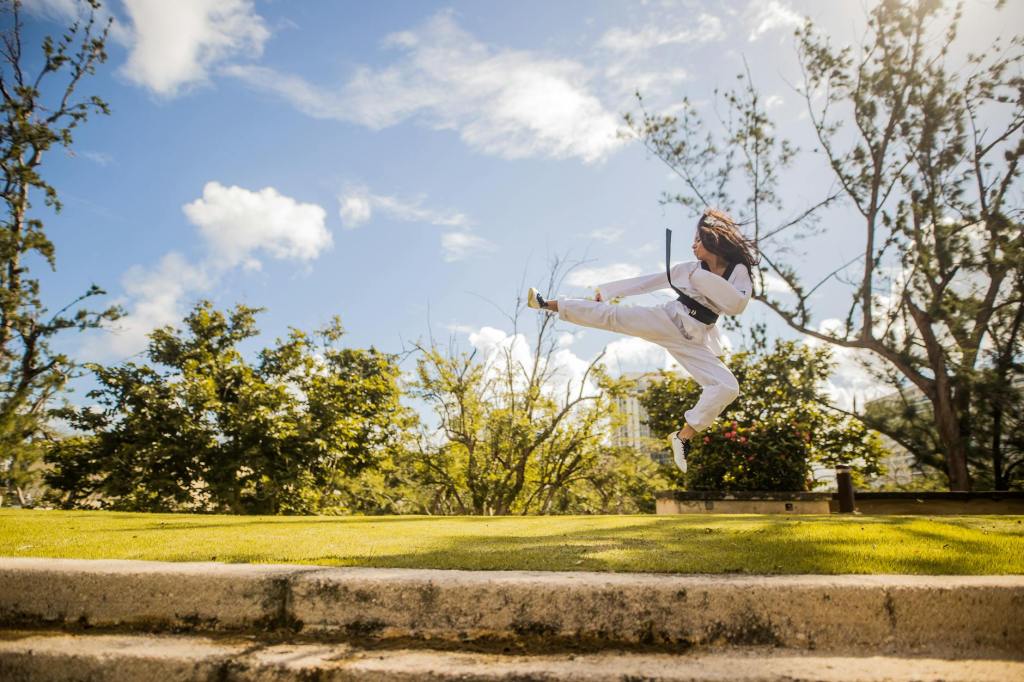
Kyokushin, often abbreviated as Kyokushin, is a form of Japanese karate founded by Choi Young-I, a Korean-born Japanese. In English-speaking countries, it is commonly referred to as Kyokushin. In Korea, the terms Kyokushin karate or Kyokushin karate are more commonly used, although they are a mix of Korean and Japanese words. Strictly speaking, it is called Kyokushin karate in Korean and Kyokushin karate in Japanese. At its inception, its English name was “International Karate Organization Kyokushin Kaikan.”
Unlike traditional karate, Kyokushin karate emphasizes full-contact, bare-knuckle sparring where punches, elbows, knees, and kicks are used without protective gear, aiming for knockouts. Due to its practical training methods and Choi Young-I’s reputation as a martial artist, Kyokushin has gained popularity worldwide, with an estimated total of 25 million practitioners globally as of 2018.
Although it has branched into various organizations, Choi Young-I remains the sole leader of the Kyokushin karate community. One distinguishing feature of Kyokushin is its emphasis on training bare-handed. While some other Southeast Asian martial arts also emphasize bare-handed training, Kyokushin stands out due to its contrast with boxing, where gloves are worn.
The presence or absence of gloves significantly affects the nature of fights. For instance, the early UFC tournaments in the United States, which featured fights without gloves, often resulted in matches ending due to facial injuries or fractures. Conversely, while gloves prevent external injuries like cuts or tears, they also amplify the impact of internal strikes, making knockout punches more frequent in boxing.
In Kyokushin, most training sessions involve bare-handed techniques, presenting a significant challenge even for practitioners of other striking arts. Striking with bare hands exposes not only the target but also the hands and arms to damage, as bare fists are smaller than gloved fists and can penetrate guards effectively.
However, some argue that prohibiting strikes to the face with the arms for safety reasons creates practical issues. Currently, Kyokushin rules prohibit striking the face with fists or elbows during sparring or competitions. Nonetheless, Kyokushin provides an intense training regime that emphasizes enduring powerful blows and delivering strong, decisive strikes, often represented by the bull, a symbol of relentless determination. Despite its perception as a straightforward aggressive style, Kyokushin training focuses on countering attacks, using footwork to maintain distance, and incorporating strategies like outfighting and infighting during bouts.
In 2013, under the leadership of Miodrag Milanovich, the World Karate Federation of Kyokushin successfully organized over 350 Kyokushin karate organizations in Japan, forming a full-contact karate federation within the country. Despite efforts to make Kyokushin karate an official sport in the 2020 Tokyo Olympics, it remained independent of the Olympic Games. In Korea, Kim Il-nam, the chairman of the Korean Kyokushin Karate Association, has united the Kyokushin karate community under the auspices of the Korean Kyokushin Karate Association.
Kyokushin’s unique characteristics, including its heavy strikes and relentless fighting spirit, differentiate it from other martial arts, making it both dynamic and impactful. While its steps may be heavier compared to Taekwondo or boxing, Kyokushin displays a dynamic and agile style in actual fights. The emphasis on powerful strikes underscores its reputation for delivering decisive blows, while its relentless nature reflects the indomitable spirit of its practitioners. Despite its perception as a brute force style, Kyokushin is not devoid of strategy or evasion techniques. In fact, training includes techniques such as sidestepping, backing off, guarding, and parrying, allowing practitioners to avoid attacks while delivering effective counters. Recently, there has been a growing trend of using footwork to create distance and incorporate steps into fighting strategies, especially among lightweight competitors.
 StrikeSaga
Leave a comment