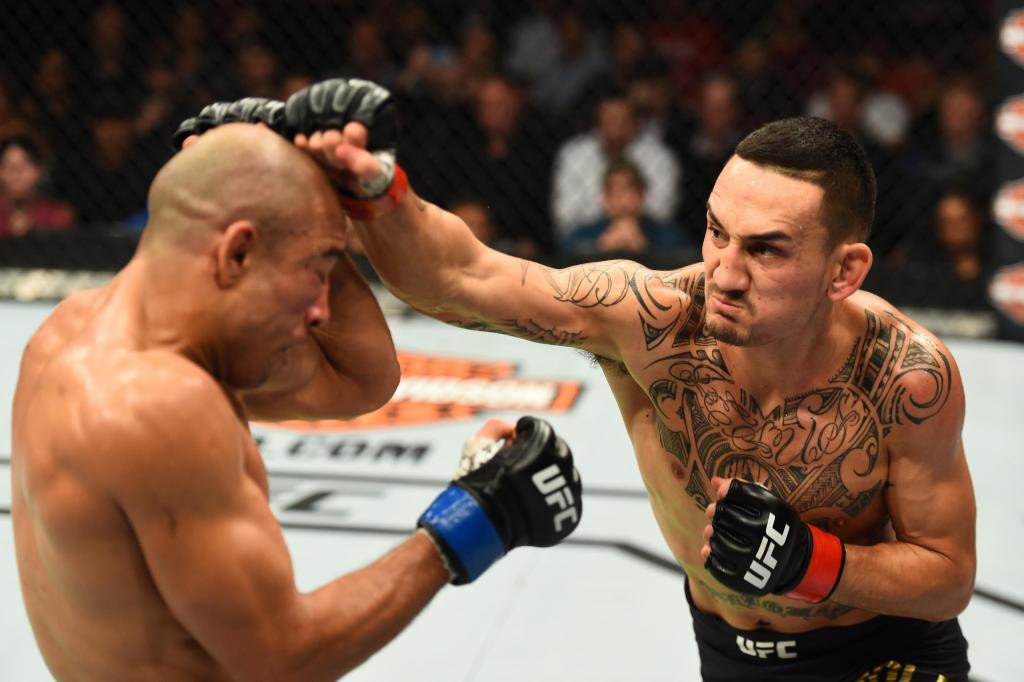
(Note: This is the third post of the Max Holloway Series)
Holloway is known for positively evolving his game, drawing significant inspiration from boxing’s top technician, “Hi-Tech” Vasyl Lomachenko, whom he openly acknowledges as a benchmark for his style, alongside other fighters like TJ Dillashaw.
In Lomachenko’s fights, several key elements stand out: diligent lead punches and feints, footwork and angles, and excellent rhythm and follow-up combinations. Holloway, among current boxer-like MMA fighters, stands out for his adept utilization of these aspects.
In the fight against Brian Ortega, one glaring issue with Holloway’s opponent was his tendency to remain stationary with his feet despite actively using shoulder defense and head movement. While this style might suffice against opponents favoring straightforward, single-power shots (as it could deflect or at least absorb some of the initial onslaught), it becomes problematic against opponents who maintain a high tempo, continuously moving forward, and throwing multiple strikes, especially from angles that aren’t directly in front.
While head movement might evade direct punches, exposing the sides is inevitable, particularly against opponents employing lateral movement. In the context of 4-ounce fighting, one might evade a few strikes but not all, rendering such a strategy unsustainable.
A stark example of this was evident in the Bobby Green vs. Dustin Poirier fight, where Green’s reliance on absorbing strikes ultimately led to the match’s conclusion. In such cases, incorporating leg movement is imperative for a secure and effective defense.
This vulnerability becomes more pronounced against opponents like Holloway, who possess similar reach and footwork proficiency as Ortega. Many MMA striking trainers have predicted that Holloway’s length and speed could pose significant challenges for Ortega. For instance, Holloway’s adept feints and paint motions provide varied rhythms, making his straight attacks that follow more concise and difficult to predict. After the initial exploration phase against Ortega, Holloway recognized slight issues with Ortega’s footwork and evasion style (attributed to relative lack of coordination in the upper and lower body).
He then capitalized on Ortega’s habits during exchanges (such as remaining static and absorbing blows), inducing Ortega’s initial responses with double and triple jabs and feints. After establishing head movement patterns, Holloway steadily accumulated damage by either landing precise strikes or targeting a fixed body position.
 StrikeSaga
Leave a comment