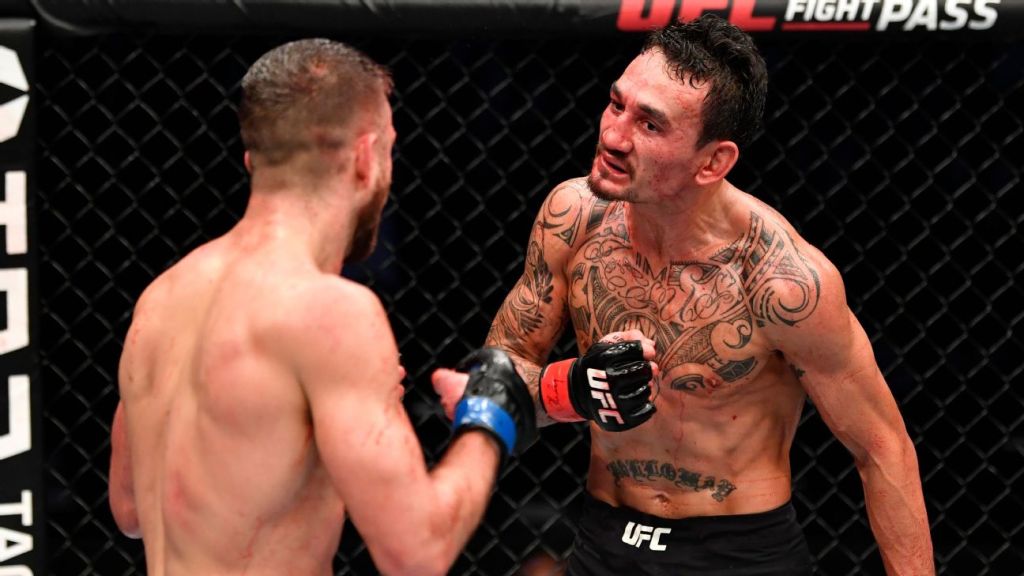
Max Holloway is famous for being a slow starter, with most of his finishes in recent times coming around the late stages of the 3rd, 4th, or the 5th round. He never seems to rush. Understanding that 25 minutes is a considerable amount of time, he pours out an almost unlimited volume of strikes after his “exploration phase.”
Historically, champions on remarkable winning streaks have always had remarkable composure and adaptability. Furthermore, secret of the maestros of striking, who display machine-like near-perfect performance in fights, lies in deep exploration and understanding of their opponents.
Holloway is no exception to this structure, and during what could be considered the first stage of exploration, he shows little signs of significant aggression. He spends about a round focusing a bit more on defense, patiently waiting and studying the opponent’s reactions to his jabs, body shots, and one-twos from a distance, reacting to his opponent’s reactions to his own in-and-out movements, attack or defense habits, styles, etc. Constantly probing with his jabs, landing shots to the body, changing up the sequence and tempo of jabs and one-twos while successfully landing his concise shots from a distance, he’s satisfied with what can be called potshots at this stage. (Potshots are light, crisp shots in boxing that come out like unexpected stabs at precise timings. They’re not particularly heavy, but sharp and definitely shouldn’t be underestimated.)
However, he relentlessly engages in exchanges, inflicting small amounts of damage over time and drawing reactions from his opponent without giving them a moment to rest or space to breathe. This prevents the game momentum from shifting to the opponent.
Consequently, by around the 2nd round, the opponent’s patterns and timing become gradually familiar and ingrained in his mind.
(Although the exact principle is unclear, athletes as exceptional as Holloway seem to possess an innate ability to physically perceive and learn their opponent’s attack rhythm and patterns. Unless it’s a devastating blow, they continue to observe and even utilize their opponent’s attacks, even if they’re hit… Perhaps, under the guidance of the coach, constant learning of the range of punches the opponent could throw in different situations, combined with a certain innate animalistic intuition and sensory perception, leads to this result.)
Now, Holloway starts to unleash bolder attacks and longer combinations tailored to exploit the opponent’s habits and tendencies further, beginning to accumulate damage more severely. This marks the commonly known phase as “volume punching” in Holloway’s game, where his volume of strikes increases gradually.
The remarkable balance ability and coordination between his upper and lower body, as well as his hands and feet, create opportunities for Holloway to engage in exchanges and enter clinches without falling into significant risks. When the opponent makes mistakes, Holloway capitalizes on them by varying angles and combinations with relentless exchange attempts. This is the second stage, where as the opponent starts to realize their injuries and fatigue, Holloway becomes more overt in his attempts to finish the fight, launching a barrage of attacks such as transitioning from 1-2 to 1-2-3, 1-2-3-4, or even more, resembling a fully heated machine gun with increasing rounds per minute. If the opponent allowed significant openings during the initial exploration phase, Holloway becomes even more relentless.
As seen in the Ortega fight, Holloway comfortably gets his way out of Ortega’s big attacks and counters with precision strikes, emphasizing the classic ‘Make’em miss, make’em pay’ principle advocated by striking coaches. When the opponent repeatedly makes mistakes, they either react with oversensitive action or continue to guess, which Holloway can further exploit.
Especially, the hallmark of Holloway’s high-volume game and his style of breaking down opponents lie in the volume that goes beyond the opponent’s expected range. For instance, if the opponent responds to Holloway’s combination by exchanging 2-3 punches, Max always maintains a higher output, especially delivering more shots towards the end. His relatively fast hand-speed plays to his advantage here.
So, while most fighters would typically exchange blows two or three times and then need to readjust, Holloway consistently lands more shots and continues to shift the tempo, creating a situation where the perceived volume of strikes by the opponent surpasses the actual volume thrown. This means that while the opponent is usually focused on recovering, rebalancing, and emphasizing defense, expecting the average density of exchanges most fighters adhere to, Holloway pushes the pace even further beyond what they anticipate. This scene repeats continuously, and as Holloway seizes control of the pace and momentum of the fight, he naturally transitions into the third stage.
The third stage is essentially the “finishing phase.” Once the opponent can no longer aggressively advance on Holloway and begins to show signs of fatigue and accumulated damage, whether backing off or retreating, the dynamics of the fight shift towards Holloway relentlessly pressing on for the finish, resembling a close-quarters combat scene, leveraging body-head combinations in indiscriminate attacks.
During this time, Holloway maintains a footing closer to planting rather than lightly moving when hitting. He even has the ability to track his opponent’s movements even when they’re moving. For instance, countering Ortega’s retreat with precise shots even as Ortega tries to evade is a clear display of Holloway’s exceptional striking balance. There are other fighters in the featherweight division who can play in this style, like Swanson, but even Swanson doesn’t execute the shifting nearly as smoothly and delicately as Holloway does. He tends to favor a slightly heavier and more powerful shifting. This is why Holloway’s balance in striking is oustanding, even within the incredible talent pool of strikers that the UFC has.
He pushes forward with a mixture of forward shifting and continues to pressure when it’s time to finish. Holloway has the ability to keep up with his opponent’s pace even when they’re moving. Holloway’s ability to land four or more precise strikes on Ortega’s face even as Ortega retreats in the face of danger, without a hint of hesitation, demonstrates how exceptional his striking balance is. Since he relentlessly lands blows even when the opponent should be regaining balance, the opponent feels the intense pressure of the high pace and accumulates more damage. As a result, if the opponent reacts with oversensitivity to this pressure or tries to retaliate more desperately, they’re only more likely to get hit even more.
Overall, Holloway’s ability to elongate the fight by patiently exploring and conserving energy in the early rounds allows for these extended, strategic finishes in the later rounds. When combined with his characteristic body-snatching instincts, the ability to shift the tempo, and the numerous combinations he can fluently execute, he can conserve energy, focusing on delivering ample shots and attacks to wear down his opponent. Naturally, this makes the later rounds much more challenging for opponents in terms of stamina and mental clarity. Hence, most of Holloway’s recent opponents haven’t been able to hear the final bell.
 StrikeSaga
Leave a comment